| Scientific name: Avocettina infans | 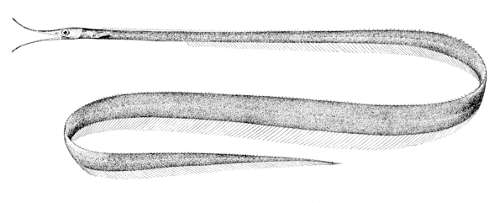 |
| Nome comum: N/A |
| Common name: Avocet snipe eel |
| Classification: CHORDATA > ACTINOPTERYGII > Anguilliformes > Nemichthyidae |
| Description: Body very elongate. Anus located shortly behind pectoral fins. Jaws and snout produced into a long non-occlusible beak in females and immature males; shorter in mature males. Upper jaw longer than lower jaw. Small teeth. Colour brown or black, becoming darker at maturity. |
Global Distribution: Circumglobal in tropical to temperate waters. Mostly in the northern hemisphere.
View Map |
| BIOLOGICAL FEATURES |
| Size: Maximum length 74.5 cm (total length). |
| Age: |
| Weight length rel.: FishBase: Bayesian estimated length-weight: a=0.00102 (0.00046 - 0.00225), b=3.06 (2.88 - 3.24). |
| Growth type: |
| von Bertallanfy growth parameters: |
| Reproduction: Oviparous, with planktonic leptocephali larvae. Degenerative changes in males and females suggest semelparity (reproduces only once). |
| Maturity: |
| Behavioural ecology: |
| Population structure & migrations: |
|
| ECOLOGICAL FEATURES |
| Depth range: FishBase: 0 - 4580 m, usually 1200 - 2000 m |
| Habitat: Meso- and bathypelagic. |
| Feeding habits: Feeds on crustaceans, mainly shrimp. |
| Trophic level: Fishbase: 3.5 |
|
| FISHERIES |
| Commercial interest: Not commercial. |
| Conservation status: Not evaluated. |
| Nutritional information & food safety: |
|
| REFERENCES |
Carpenter K.E., ed. (2002). The living marine resources of the Western Central Atlantic. Volume 2: Bony fishes part 1 (Acipenseridae to Grammatidae). FAO Species Identification Guide for Fishery Purposes and American Society of Ichthyologists and Herpetologists Special Publication No. 5. FAO, Rome, pp. 601-1374.
Froese R., Pauly D., editors (2011). FishBase. World Wide Web electronic publication. www.fishbase.org, (06/2014). http://www.fishbase.org/summary/Avocettina-infans.html
Hureau J.-C., ed. (1984-1985). Fishes of the North-Eastern Atlantic and the Mediterranean. UNESCO. Accessed through: Marine Species Identification Portal. World Wide Web electronic publication. http://species-identification.org/index.php (2014).
IUCN (2014). The IUCN Red List of Threatened Species. Version 2014.1. www.iucnredlist.org |
|